by Mallory Cleere, Visitor Services Assistant
Armistead Peter 3rd, 1919 Pierce-Arrow
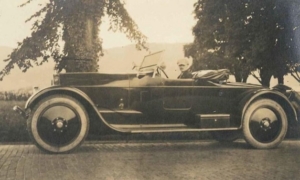 This 1919 Pierce-Arrow 48-B5 Roadster was owned by Armistead Peter 3rd, the last proprietor of Tudor Place. It was gifted from his father, Armistead Peter Jr., and mother, Anna W. Williams, for his 23rd birthday in the year of its release. Armistead 3rd frequently embarked on joyrides in it through the roads of Georgetown every weekend*. The vehicle was personally designed from the outset; modifications to its exterior—such as the installation of an external lockbox and alterations to the chassis, steering wheel and front seat—were commissioned by Armistead Peter 3rd [1]. Armistead 3rd often remarked that the only rival for his affection, aside from his wife, Caroline Ogden-Jones, was the cherished Roadster.
“European by birth, American by adoption [2],” the automobile made history in the 1920s as the symbol of independence and individuality in American society. The era’s so-called “Prohibition Cars” featured two defining qualities. The first was their individualistic custom designs, which featured the “living beauty of line” that made them the very symbol of modernity [3]. The second was the social impact these cars had in the era. Also known as “gasoline aristocracy,” the consistent efforts of various automobile makers, in particular the Pierce-Arrow Company, made for the sole purpose of producing expensive luxury cars [4]. This was done so that those who purchased them could gain a level of social acceptance from the established elites within cities.
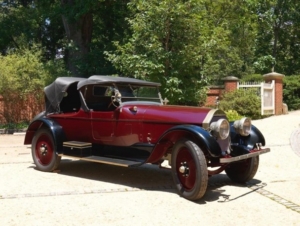 This particular automobile was custom-made with designated changes at Armistead Peter 3rd’s behest. He was known to have driven this specific car until his death in 1983. As one of the established elites, Armistead 3rd was quoted as saying, “Do not entrust the maintenance and repair” of anything on the property (including the beloved car) to any “untrained personnel…Good care is not cheap in the short view, but over the years, it pays for itself over and over in absence of breakdowns and longer life [5].”
The Merging of Social Classes and the Importance of Appearance
It’s all about appearances.
The year 1900 signified the beginning of a new tradition for New Yorkers. The New York Automobile Show debuted in Manhattan for the first time, featuring automobiles from all the major giants who dominated the auto industry. Working Americans saw the possibility of a utopian, horseless age where every person had the right and the ability to own and travel via the leading, most sought-after technological revolution [6]. By 1905, this exhibition was the “nation’s leading industrial exhibit, and by 1907 the automobile was commonly referred to as a necessity [7].”
The automobile swept America by storm. Though considered European by design, it soon became a staple of American society and culture [8]. The country’s vast landscape made automobiles increasingly essential for the masses, and soon, the automobile transformed from a luxury commodity into a mass-produced item to which every household was entitled. The invention introduced new cultural ideals. The automobile provided newfound societal freedom to middle-class men as they showcased their material gains from purchasing this new form of transportation. With their own earnings, middle-class Americans could buy a symbol of modernity [9]. A staple of the nation’s growing conspicuous consumption, the auto industry was seen as the frontrunner of American technological idealism.
“Imagine a healthier race of working men,” wrote the New York Independent in 1904. Publishers envisioned the newfound benefits of automobiles for workers, “…toiling in cheerful and sanitary factories [10].” The idea was that personal transportation provided a sense of freedom and established a realistic, positive aspiration for middle-class working men. This pursuit of purchasable freedom rendered even the most challenging working conditions to appear as if they were encountered with a “cheerful” demeanor.
It created a new subculture in which many men bonded over the make and models of their cars, often gaining a sense of community and superiority by working on and repairing their own autos [11]. The American automobile was considered an essential asset in many social classes of the era . For the first time, an innovative technology was introduced that swiftly became accessible to a wider demographic rather than solely the wealthiest Americans.
Thus, this created a new connection with society’s elites that had never previously existed. Now, a middle-class man could appear just as affluent as those who had dominated the economic world for decades . “Thank God we live in the era of the motor car!” stated Scribner’s Magazine in 1913, as reporters expressed a newfound optimism about the automobile’s impact on society [12]. The social classes were converging, and as the Progressive Era concluded with the onset of World War I, the upper class became acutely aware of the developing similarities associated with automotive culture.
By the end of the Progressive Era, social elites of the day became increasingly interested in distinguishing themselves from those of the ‘common masses.’ The factory line of ‘cookie-cutter’ autos gave the appearance of economic equality. If all automobiles looked the same and were considered an attainable social goal, how were the elites supposed to carve out their own space in this emerging culture? Doctor Peter J. Hugill (Professor of Geography and Philosophy at Texas A&M University) wrote, “The forces of mass production and scientific management epitomized by Ford’s Model T… expanded standardization to most areas of American life [13].” The Model T, also known as the working man’s car, set the norm of how automobiles ought to appear: streamlined and common in every aspect. This feature “standardized” appearance across all American social classes.
Additionally, the process of making automobiles led to the emergence of ‘factory line’ products. With the rise of conspicuous consumption, the public began purchasing items that were no longer unique. A middle-class household could possess the same products found at an ‘old money’ estate. Items such as cookware, sewing machines, patterns and tableware were produced in mass quantities and sold to people of all social classes. As this became the norm, the social elite began seeking luxury alternatives to everyday products. Nowhere was this more evident than in the automobile culture of the 1920s.
“The Nineteen Twenties was not merely a period of accelerated change,” wrote author Ashleigh Brilliant in his book “The Great Car Craze: How Southern California Collided with the Automobile in the 1920s.” “The ethos of that decade set it quite distinctly apart from any other period in America’s past or in her foreseeable future [14].” With the emergence of speakeasies, flappers, jazz and overall Prohibition rebellion, the country underwent a cultural revolution. The accelerated period of change streamlined the merging of social classes and made the need to distinguish the elites from the middle class all the more potent. This need, reflected in car culture, caused the established elites to turn to manufacturers who were willing to create custom cars, unlike what was seen through the Ford Industry.
“…auto manufacturers succumbed to a passion for “conspicuous pro-duction,” wrote Duke University’s Michael Heinrich Maiwald. “…which, much like the “conspicuous consumption” from which the term is taken, sought to reaffirm elite status by manufacturing upscale cars fit only for their peers [15].” Enter the Pierce-Arrow company—one of America’s finest and most elite sought-after automobile manufacturers.
Founded in 1865 by George M. Pierce, the Pierce-Arrow company opened in Buffalo, New York as a manufacturer of domestic goods [16]. Having begun through the craze of conspicuous consumption, manufacturing those ‘cookie-cutter’ items mentioned above, the company soon realized that the lure of conspicuous production was too tempting to resist. Starting in 1900, the same year as the first New York Automobile Show, the company switched to solely producing automobiles. In competition with the ‘working man’s car’ created by Ford, Pierce-Arrow took a different approach, responding to the demands of the social elite throughout the early 20th century. According to Maria Drevet of The Studebaker National Museum, the Pierce-Arrow “quickly gained a sterling reputation in the luxury car market due to its uncompromising quality [17].” It was known as the best of the best, and no custom design was too much.
In today’s vocabulary, Pierce-Arrow means very little unless one is a historian specializing in Prohibition-era cars or a car enthusiast. The company no longer exists, having never recovered from the financial strain of the Great Depression [18]. This was not the case throughout the 1920s and through Prohibition. Pierce-Arrow was the maker of luxury cars. It symbolized grandeur, financial abundance, good breeding and luxury living [19]. In today’s language, it can be compared to Lamborghini or Rolls-Royce [20]. Though, unlike today’s luxury cars, the Pierce-Arrow held a cultural meaning that defined the automobile culture of the 1920s.
A luxury car for an affluent market. “…in ways that deliberately invite comparison with the figural and ethical dilemmas of a philosophical Romanticism…[the] Pierce-Arrow: a luxury motor car that had its greatest success in the twenties…the car’s “living beauty of line” made it the very emblem of modernity… [21]”
It’s all about appearance.
Finally, there was a company that catered to the social elite and offered them a means to dominate automobile culture as they had before Henry Ford made the car a common commodity. “Custom automotive coachbuilding,” Hofstra University’s Matthew C. Sonfield called it. “From the early days of the automobile until the sobering years of the Great Depression, a market existed in the United States…for custom-designed and crafted automobile bodies. Some wealthy men and women; not content with the standard offerings…were willing to spend additional sums on coachwork custom designed and built… [22]” If a wealthy client was not content with the make and model from their initial purchase, they could rebuild and redesign from the chassis on up, making the cars more luxurious and independent from the rest. Companies such as Pierce-Arrow were more than willing to accommodate this.
The 1919 Pierce Arrow 48-B5 Roadster at Tudor Place in Georgetown underwent such changes. The original owner, Armistead Peter 3rd, was known to have made custom change requests to the Pierce-Arrow company before physically receiving the 1919 48-B5 Roadster from his parents as a birthday gift [23]. This specific roadster tells the story of Prohibition auto culture and the elite’s importance of appearance.
Born from the context above, this car fit the definition of “gasoline aristocracy” perfectly.
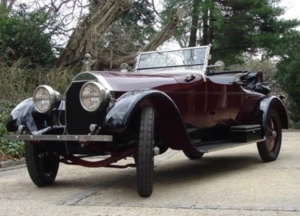
1919 Pierce-Arrow 48-B5 Roadster [24]
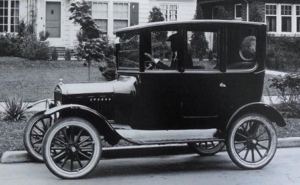
The 1919 – 1922 Model T Ford [25]
Look at the Armistead Peter 3rd’s Pierce-Arrow next to the “common man’s” Ford Model T: Everything from the color to the length and width of the cars is different, yet both were made with the same available technology in the same year. The Peters’ automobile is built for appearance and luxury. The bright, polished red of the body, the removable top, larger headlights, larger wheels and slick silver linings were all designed to gear one’s attention toward appearance. And through that appearance, the renowned old money family could then demonstrate how they were a cut above the rest in automotive culture.
In contrast, the Model T was made of less material, had a top speed of 30 mph rather than 70 mph, featured no bright colors, had smaller headlights, a smaller frame and was solely designed to get a person from point A to point B with little to no fuss or attention. The small chassis made “custom automotive coachbuilding” virtually impossible, unlike the Pierce-Arrow.
The Pierce-Arrow could be made as luxurious and unique as possible if one had the money to pay for it. The Model T, the most common brand of car in America in the 1920s, was not built for such accommodations.
The Model T originated from a car culture that brought different social classes together. In contrast, the Pierce-Arrow was designed to differentiate those classes. It was costly to maintain, often needing personal mechanics and chauffeurs—amenities that Armistead Peter 3rd enjoyed. Conspicuous consumption fostered a sense of shared identity through products.
Conspicuous production established social hierarchy within those product companies.
What resulted was a decade of Prohibition-era cars that focused on appearance. The more luxurious the car, the higher one appeared on the social ladder. An era of “gasoline aristocracy” dominated city streets. The car culture that began at the turn of the century took on a new chapter and those with money, such as Georgetown’s Peter family, dominated the story.
*Armistead Peter 3rd paid Brewster & Company of New York City to manufacture the body according to his specifications. Brewster incorporated a new seat and steering wheel design from Rolls Royce, to accommodate Peter’s height, and German silver bell-shaped headlights, also designed by Rolls Royce. Total cost for the chassis and body was $8,482.70, a fortune in 1919 considering most workers earned around $1300 per year. -Robert DeHart
[1] “The Pierce-Arrow Roadster.” Tudor Place, April 2024. https://tudorplace.org/museum/collection/roadster/.
[2] James J. Flink, “Three Stages of American Automobile Consciousness.” American Quarterly 24, no. 4 (1972): 451–73. https://doi.org/10.2307/2711684. 452.
[3] Peter Nicholls and Susan Howe, “‘The Pastness of Landscape’: Susan Howe’s ‘Pierce-Arrow.’” Contemporary Literature 43, no. 3 (2002): 441–60. https://doi.org/10.2307/1209108. 442.
[4] Donald Finlay Davis, Conspicuous production: Automobiles and elites in Detroit, 1899-1933. Philadelphia: Temple University Press, 1988.
[5] Armistead Peter 3rd, Tudor Place. Washington DC, District of Columbia: Georgetown, 1969. 90.
[6] James J. Flink, “Three Stages of American Automobile Consciousness.” American Quarterly 24, no. 4 (1972): 451–73. https://doi.org/10.2307/2711684. 454.
[7] James J. Flink, “Three Stages of American Automobile Consciousness.” 454.
[8] James J. Flink,. “Three Stages of American Automobile Consciousness.”452.
[9] Blaine A. Brownell, “A Symbol of Modernity: Attitudes Toward the Automobile in Southern Cities in the 1920s.” American Quarterly 24, no. 1 (1972): 20–44. https://doi.org/10.2307/2711913. 3.
[10] “The Automobile Age.” The Wilson Quarterly (1976-) 10, no. 5 (1986): 64–79. http://www.jstor.org/stable/40257092. 67. Published in the Winter 1986 issue with no credited author.
[11] Kathleen Franz, “‘The Open Road”: Automobility and Racial Uplift in the Interwar Years.” Essay. In Technology and the African-American Experience: Needs and Opportunities for Study, 131–53. Cambridge, Mass: MIT, 2004. 147.
[12] “The Automobile Age.” The Wilson Quarterly (1976-) 10, no. 5 (1986): 64–79. 1.
[13] Peter J. Hugill, “Good Roads and the Automobile in the United States 1880-1929.” Geographical Review 72, no.3 (1982): 327–49. https://doi.org/10.2307/214531. 344.
[14] Ashleigh Brilliant, The Great Car Craze: How Southern California Collided with the Automobile in the 1920s. Santa Barbara: Woodbridge Press, 1989. 12.
[15] Michael H. Maiwald, “White-Collar Masculinity and Class Anxiety in the 1920s American Novel.” White-Collar Masculinity and Class Anxiety in the 1920s American Novel, 1998.
[16] Maria Drevet,“Pierce-Arrow.” The Studebaker National Museum, February 7, 2022. https://studebakermuseum.org/pierce-arrow/.
[17] Maria Drevet, “Pierce-Arrow.” The Studebaker National Museum.
[18] Maria Drevet, “Pierce-Arrow.” The Studebaker National Museum.
[19] Maurice D. Hendry, Pierce-Arrow: “First among America’s finest” Ballantine Books, 1971. 1.
[20] Maurice D. Hendry, Pierce-Arrow: “First among America’s finest,” 1971. 1.
[21] Peter Nicholls and Susan Howe. “‘The Pastness of Landscape’: Susan Howe’s ‘Pierce-Arrow.’” Contemporary Literature 43, no. 3 (2002): 441–60. https://doi.org/10.2307/1209108. 1-2.
[22] Matthew C. Sonfield, “Custom Automotive Coachbuilding in the United States, 1900-1940.” Design Issues 12, no. 2 (1996): 47–60. https://doi.org/10.2307/1511713. 1.
[23] Armistead Peter Jr, “Receipt Letter Armistead Peter Jr.” Washington DC: Tudor Place, 1921.
[24] THE PIERCE-ARROW ROADSTER. 2024. Tudorplace.Org. https://tudorplace.org/museum/collection/roadster/.
[25] Peterson, Royce. The 1919 – 1922 Model T Ford. January 3, 2020. Model Ford Fix. https://modeltfordfix.com/the-1919-1922-model-t-ford/.