Evolving Rhythms: A Brief Musical History of Tudor Place


Drawing of Tudor Place Saloon. C. Sweeney, 1952, paper with crayon and marker. Tudor Place Collection & Archive.

The history of music at Tudor Place offers a nuanced lens through which to understand the intersections of class, gender, domesticity and cultural change from the 18th to the 20th centuries. The material legacy of instruments, sheet music, decorative objects and early sound technology owned by the Peter family reveals how music was more than just a form of entertainment, but a social language of refinement and adaptation. Within the walls of Tudor Place, the Peter family curated a private world of sound that echoed the evolving rhythms of American life.

Instruments and sheet music held both audible and symbolic value in elite households like Tudor Place. The music book (ca. 1783) owned by Martha Parke Custis Peter (1777-1854) attests to the significance placed on musical education for young women in elite families (1). Her grandmother, Martha Washington, insisted on musical training, reflecting how music as a domestic art form was viewed as essential to elite womanhood during the 18th and 19th centuries.

The theme of musical study continued for the entire span of the Peter family’s occupancy of Tudor Place. The spinet piano by John Broadwood & Son, built in 1804 and later purchased by Washington Peter, was not merely a musical instrument, but a marker of affluence (2). Armistead Peter Jr. brought it into the house, signaling the family’s alignment with tradition and their desire to display refinement through musical skill and patronage. Britannia Peter Kennon (1815-1911) confirmed that the transverse flute (ca. 1784-1798) belonged to her father, Thomas Peter (1769-1834)(3). Records also show that the Martin guitar (ca. 1895) as well as the family’s multiple banjos dating from the late 19th and early 20th centuries were enjoyed and played by multiple generations of the family, including Dr. Armistead Peter, Armistead Peter Jr., B.Kennon Peter and Armistead Peter 3rd (4).

By the 19th century, long-standing gendered aspects of music were shifting. The guitar and the lute were originally associated with women’s parlor music because they allowed women to play in graceful poses while maintaining their “decorum” and were not viewed as an instrument for professional male musicians outside of the home(5). Later, the guitar migrated into popular genres in American music such as folk music and later, country and rock, quickly becoming a masculine instrument (6). In contrast, the flute, which was historically a masculine instrument became more associated with femininity when women were permitted to perform in marching and concert bands (7). The decorative arts at Tudor Place, including music-themed figurines, music boxes and a ladies’ worktable painted with musical imagery by America P. Peter (1803-1842), further reflect the idealization of music in feminine education as well as a general aesthetic taste (8).

Technological innovations transformed the way music was experienced in American homes by the early 20th century. Radios, phonographs and music boxes, many of which remain in the Tudor Place Collection & Archive, marked a shift from active performance to passive listening. The presence of commercial recordings and sheet music by African American musicians like Lizzie Miles (1895-1963) and Hazel Scott (1920-1981), even at Tudor Place, a household traditionally adhering to Eurocentric music, hints at how technology exposed people to previously unfamiliar musical genres(9).

Finally, the presence of the banjos and extensive collection of banjo music books in the collection draws attention to the African roots of American folk music(10). While the Peters did not engage directly with African American musical traditions, instruments like the banjo, descended from West African instruments such as the akonting, remind us that major aspects of American music are built on cross-cultural exchange(11). The musical lives of enslaved and free Black Americans deeply shaped the nation’s music, even as they remained marginalized within spaces like Tudor Place. Tudor Place’s layered history of sound mirrors cultural shifts, technological advancements and shifting identities over time.

– Isabella Quartiere, 2025 Spring Collections Intern
Download the PDF with photos here.

Up in Arms: A Family’s Service

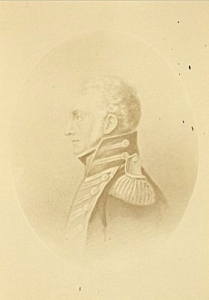
Vintage engraving portrait of G. Washington Peter c.1810-1820 in military regalia

Portrait of G. Washington Peter c.1810-1820 Engraving (Tudor Place Archive)

TUDOR PLACE TIMES | SUMMER 2024

From the early days of the United States of America through the Korean War, the Peter family proudly served in the armed forces. Through these 150 years, sons, and later daughters, were guided by a strong familial connection and an overall sense of patriotism to serve their country. These military stories are kept alive by the objects they left behind, preserved by later generations of the family.

From the early days of the United States of America through the Korean War, the Peter family proudly served in the armed forces. Through these 150 years, sons, and later daughters, were guided by a strong familial connection and an overall sense of patriotism to serve their country. These military stories are kept alive by the objects they left behind, preserved by later generations of the family.


The Beginning: Major G. Washington Peter

G. Washington Peter, born 1779, was the younger brother of Tudor Place’s first owner, Thomas Peter. Early in his life, he had a desire to join the military, running off at just 15 years old to try to join the Maryland troops and help defeat the Whiskey Rebellion. Though
he was sent home by George Washington from the Whiskey Rebellion, it would be through Washington’s recommendation that Washington Peter received his first commission to 2nd Lieutenant in the United States Army from President John Adams. While there seems to be no trace of this commission, his later commission to Captain from Thomas Jefferson is well preserved and complements his later letters while he was serving as the commanding officer at Fort McHenry in Baltimore, where he set up the first light artillery unit in the country. After leaving Fort McHenry, he later resigned his commission to protest the sale of his unit’s horses, but his drive for service never stopped. He organized a unit of the Georgetown Militia which was one of very few units to return fire with the British at the Battle of Bladensburg on August 14, 1814 before their march on Washington(1). Though his military service came to a close, George Peter held onto a seating chart from the 19th Congress where he served as a representative from Maryland where he worked alongside prominent future leaders including Sam Houston, James Buchanan and James Polk(2).

Family Tragedy: Captain William G. Williams

Captain William G. Williams found love with America P. Peter, one of the daughters of Thomas and Martha Peter right after he graduated from the Military Academy at West Point in 1824. From there he was assigned as a Topographical Engineer in Buffalo, New York. At the start of the Mexican American War in April 1846, William Williams was under the command of General Zachary Taylor whose unit was brought to Mexico. In September 1846, Taylor’s unit, including Captain Williams, was in Monterrey, Mexico. On September 21, Captain Williams was sent on reconnaissance mission and found himself in an unfortunate position when the Mexican troops started firing from Fort Teneria. General Braxton Bragg explained the story of Captain Williams’ death in a letter that included a map to Captain Williams’ son Laurence Abert Williams in 1854. He wrote in high regard of the Captain at the end of the letter saying “most nobly did he meet his fate, forgetting himself and his suffering when the cause required”(3). Accompanied by his sword, portrait and buttons from his Topographical Engineer Uniform the story of a man who gave his life for the United States at 45 years old resonated and was preserved through the family line.

Women in the War: Agnes Peter and Caroline Peter

In World War I and II, women were not able to serve on the front lines, but many women found ways to contribute to the war effort on the home front. Agnes Peter, Armistead Peter Jr.’s sister, enrolled in a boarding school in Tarrytown, New York which taught her skills like typing, driving and automobile repair. When the program concluded in summer 1918, Agnes was ready to travel to Europe to put her skills to use, but by the time her paperwork arrived, the Armistice had been signed. Yet, Europe still needed help after the war. Since she had all of her paperwork, Agnes traveled to France under the YMCA and helped people and communities there until 1921. Agnes’ passport with its cancellation stamped in 1921 shows her dedication to the work she was doing alongside the ribbons and honors she received for her humanitarian work in France(4). It was women who provided crucial humanitarian work to help countries and families rebuild following the turmoil of war. Agnes might not have been a soldier, but her wartime dedication and passion followed her family legacy of service. Caroline Peter, wife of Tudor Place’s final owner, Armistead Peter 3rd, served in a similar role as a nurse for the American Red Cross during both World War I and World War II(5). She served in these roles at the same time her husband, Armistead Peter 3rd, was serving in the U.S. Navy. As the last private owners of Tudor Place, Caroline and Armistead continued the family legacy of patriotism and service as they both served during those wars. The Peter family, over more than a century, proudly embraced military service and a deep love for their country that was preserved through generations.

– Alex Brandis, Spring 2024 Collections Intern

Source List:
1. MS-4 Finding Aid; Major George Peter Biographical Sketch
2. House of Representatives Seating Map, 19th Congress by A.J. Stansbury 1825 (MS4, Box 3,
Folder 22, Document 3)
3. Braxton Bragg to Laurence Albert Williams Describing the Battle of Monterey, September 24,
1954 (MS12, Box 1, Folder 7)
4. Agnes Peter’s World War I United States Passport, 1918
5. MS-22 Finding Aid; Caroline Ogden-Jones Peter Biographical Sketch

Britannia and Armistead: Generations of Stewardship

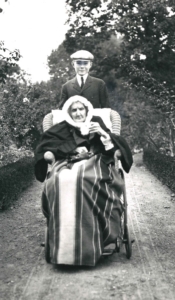
Armistead Peter 3rd pushing Great Grandmother Britannia Wellington Peter Kennon in wheelchair c.1910. C34

by Mark Hudson, Executive Director

Born over eighty years apart, Britannia and Armistead shared a bond that was expressed in their correspondences and the memories he shared in his 1969 book, Tudor Place. It was a bond not only of affection, but of intention—with both committed to preserving Tudor Place for future generations.

Read full article here.


Armistead and Britannia c. 1910

Beautifying Every Corner: The Georgetown Garden Club

The Georgetown Garden Club helped rehabilitate the Box Knot at Tudor Place.

At the 2021 Garden Party on September 22,* Tudor Place will honor the Georgetown Garden Club for nearly a century of service to the community and decades of support for garden projects at Tudor Place. The relationship between the two organizations runs deep, going back to the earliest days of the Garden Club.

Click here to read the full article from the Tudor Place Times. 


* The 29th Annual Garden Party will be held September 22, 2021 and honor the Georgetown Garden Club. Additional gala details can be found here. The 28th Annual Spring Garden Party on May 20, 2020 was canceled.

Tudor Place Times – Winter 2019

Tudor Place Times — Fall 2018

Tudor Place Times – Summer 2018

Tudor Place Times · Winter 2018

Tudor Place Times · Fall 2017

Tudor Place Times · Spring 2017